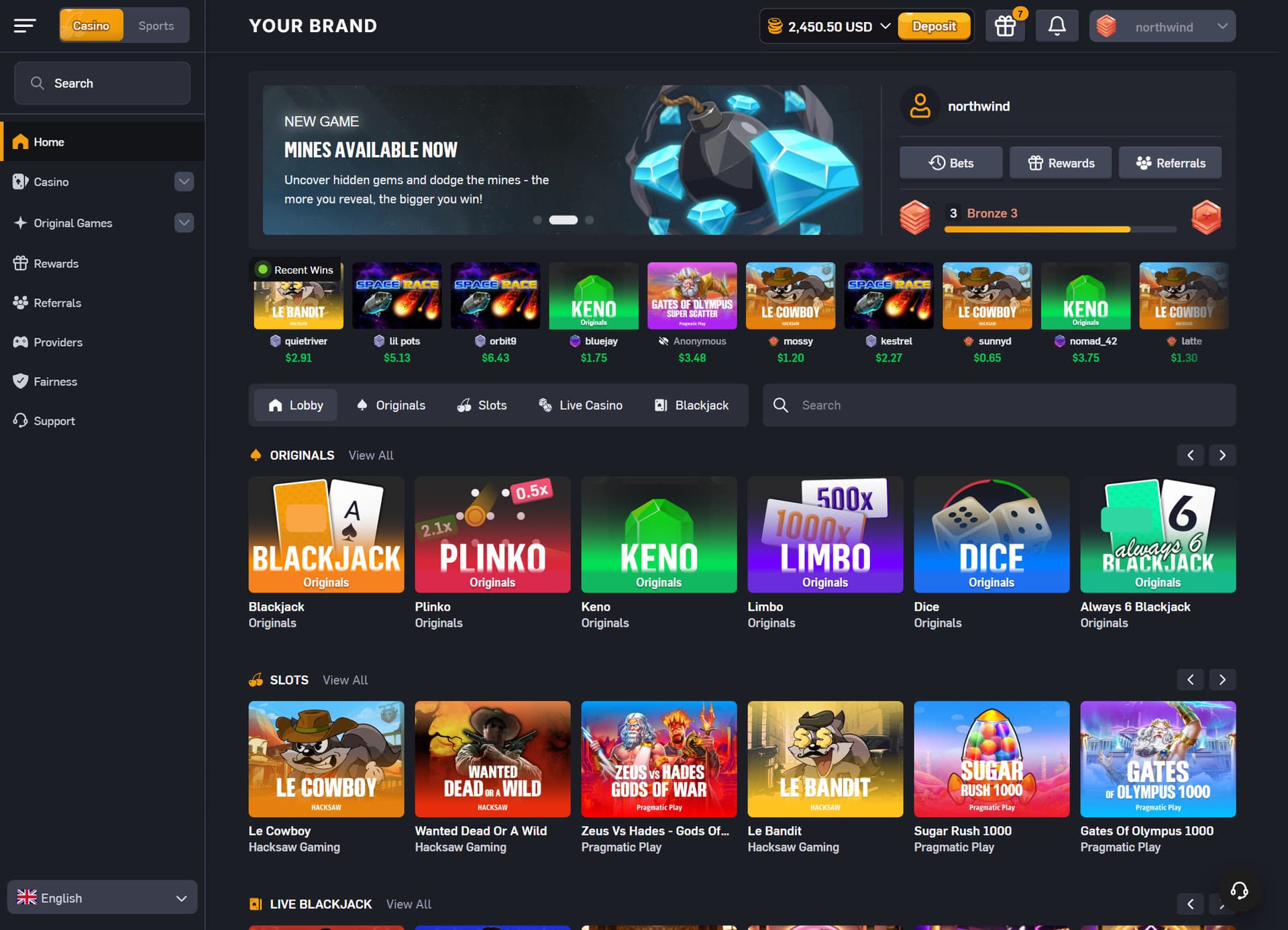
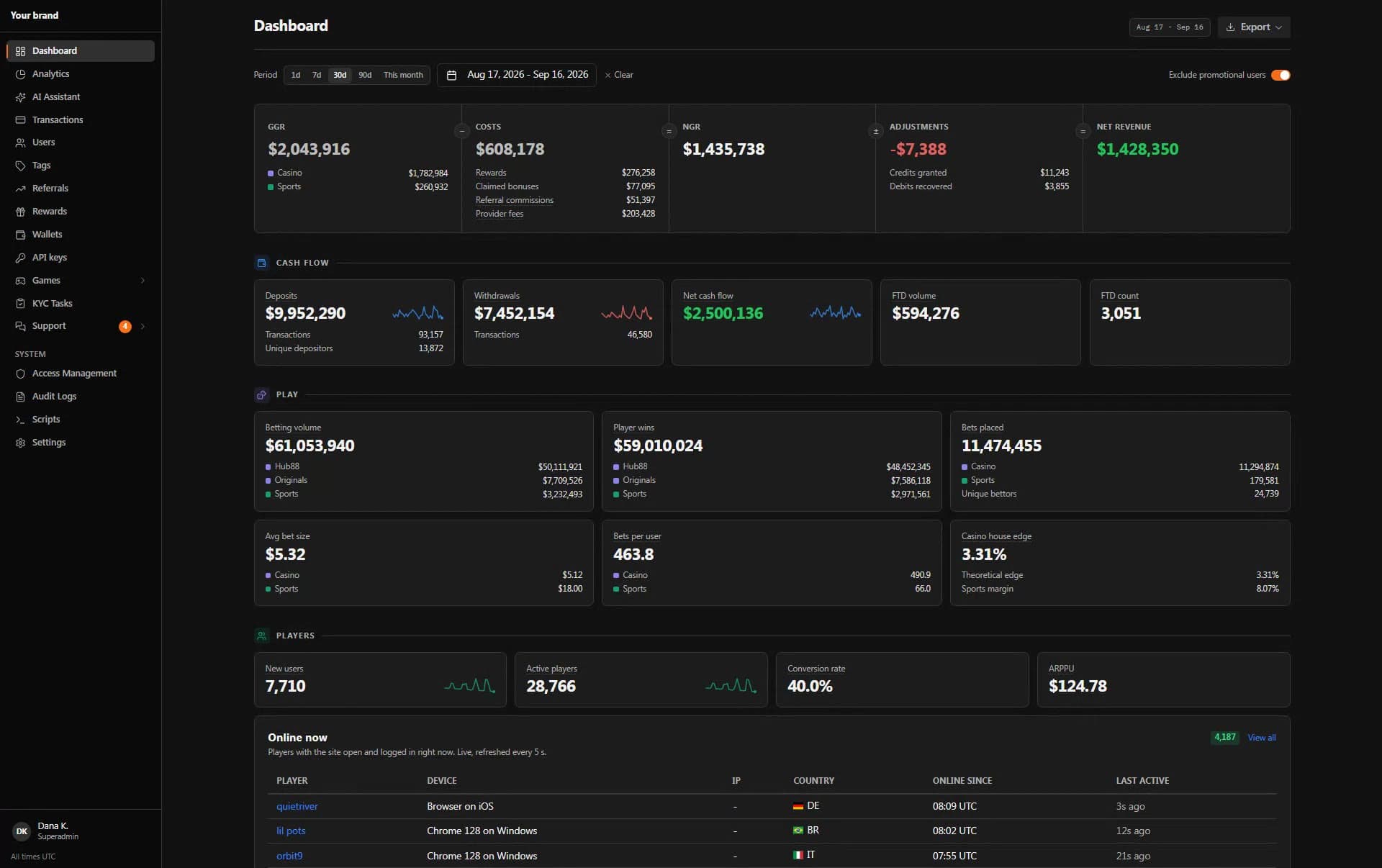
A white label puts your brand on the provider's platform, under the provider's licence. It is the quickest and cheapest start, but the licence, the payment accounts and usually the player database stay with the provider. A turnkey platform runs on your own licence: more setup, a smaller share of revenue to the provider, and a business you own. In-house means the platform runs on your own infrastructure with your own team: the most control and the most responsibility. For most first crypto casinos the real choice is between the first two, and it comes down to one question. Do you want to own the licence?
The three models side by side
| White label | Turnkey | In-house | |
|---|---|---|---|
| Whose licence | The provider's | Yours | Yours |
| Payment accounts | Usually the provider's | Yours | Yours |
| Player database | Usually the provider's | Yours | Yours |
| Who hosts and updates | The provider | The provider | Your team |
| Upfront cost | Lowest | Moderate | Highest |
| Ongoing cost | A larger share of revenue, often with a reserve held from player balances | A setup fee, then a smaller share of revenue or a monthly fee | Your own team, plus any support you buy |
| Time to launch | About a month faster than turnkey | 3 to 6 months, including the licence | Longest, unless the build is handed over ready |
| Design and features | Within the provider's template | Your own design, and custom features by agreement | The platform's own, plus whatever your team adds |
| If you part ways | The licence stays behind | Your licence and your data go with you | Nothing to leave |
White label
A white label is the fastest route to a working casino. You pay a setup fee and give the provider a share of revenue, and your brand runs on their platform under their licence. What you own is, in practice, the domain.
Before you sign a white label, check
- The rolling reserve: providers commonly hold 15 to 25% of customer balances
- The players: what you receive, in writing, if you leave
- The provider's licence: your brand goes down with it
- The way out: whether you can move to your own licence later without starting again
A white label fits when you want to test a brand quickly, have little capital, and accept that the business is not yet fully yours.
Turnkey
On a turnkey platform you hold the licence, the company, the bank and payment accounts, and the supplier contracts. The provider builds, hosts and updates the platform. The licence is an asset you can sell, and so is the business built on it. The setup fee is higher and the launch takes longer, mostly because of the licence. The provider's share of revenue is usually smaller, though, so the model gets cheaper than a white label as the casino grows.
Before you sign a turnkey deal, check
- What the package includes: a CRM, live chat, affiliates and the back office, or a separate bill for each
- Help with the licence, and what that help consists of
- Who owns the player data, and how you export it
- How design changes and custom features are priced
- How long other casinos took from signed agreement to first players
Turnkey fits when you are building a brand to keep, have the budget for a licence, and want to own what you build.
In-house
In-house means the platform runs on your own infrastructure with your own engineers. There are two ways to get there: build it from scratch, or take a platform that already runs live casinos and have it set up on your own servers.
Building from scratch is the slowest and most expensive route. A platform worth running, fast under load and secure enough to hold real money, costs more than $500,000 to build before any marketing. Cheaper builds and ready-made scripts exist, often clones of a well-known casino's look, but they tend to slow down when traffic peaks and to leave holes an attacker can find, and the savings go on fixing them.
Even a well-built platform meets its hardest problems only once real players and real money arrive: payment edge cases, bonus abuse, the traffic of a big promotion. A platform that live casinos already run on has been through those, and the fixes are in the code you receive.
Built from scratch
- Where you start
- An empty codebase
- Its first real test
- Your own launch, with your players' money
- What it covers
- What your team has had time to build
- After launch
- Your team finds and fixes what breaks
A proven platform, in-house
- Where you start
- A platform live casinos run on today
- Its first real test
- Already passed, on live brands
- What it covers
- Everything those casinos use every day
- After launch
- Your team builds on it, with the provider's updates if you want them
Before you sign an in-house build, check
- The track record: which live casinos run on the platform today, and for how long
- The code: exactly which rights you get, and whether you may change and extend it
- The handover: the documentation, the training, and how long the provider stays beside your engineers
- Afterwards: who supports the platform, and how updates reach you
In-house fits groups with an engineering team, a board that wants the system on its own books, or markets that require local hosting.
How to choose
Do you want to own the licence?
If not, a white label. If you do, turnkey or in-house.
How much can you spend before the first deposit?
A white label needs the least.
How fast must you be live?
A white label is about a month faster.
Do you have engineers who want to run the platform?
If you do, consider in-house, on a platform that already runs live casinos.
What happens if you part ways?
Ask every provider to answer in writing.
Where BTX fits
BTX is not a white label: every casino on it runs on its operator's own licence. We offer two models, both on the platform our own casinos run on. Turnkey, where we set up, host and update it on your own deployment. And in-house, where we set it up as your own deployment and hand it over with the code, yours to develop further. If you have no licence yet, we give full guidance through the application and introduce you to licensing agents. Compare the two plans or read how in-house works.
This guide is general information, not legal or financial advice.